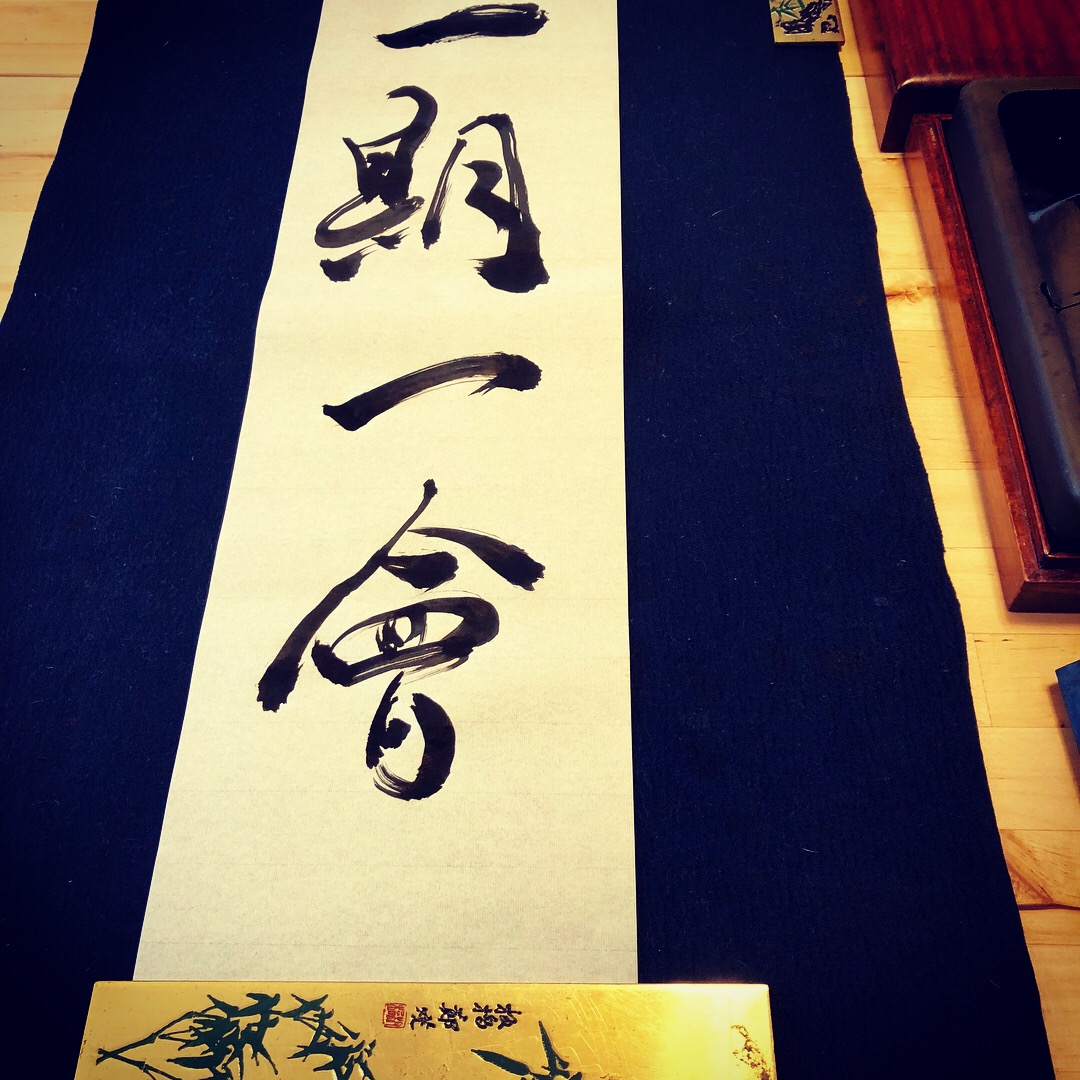
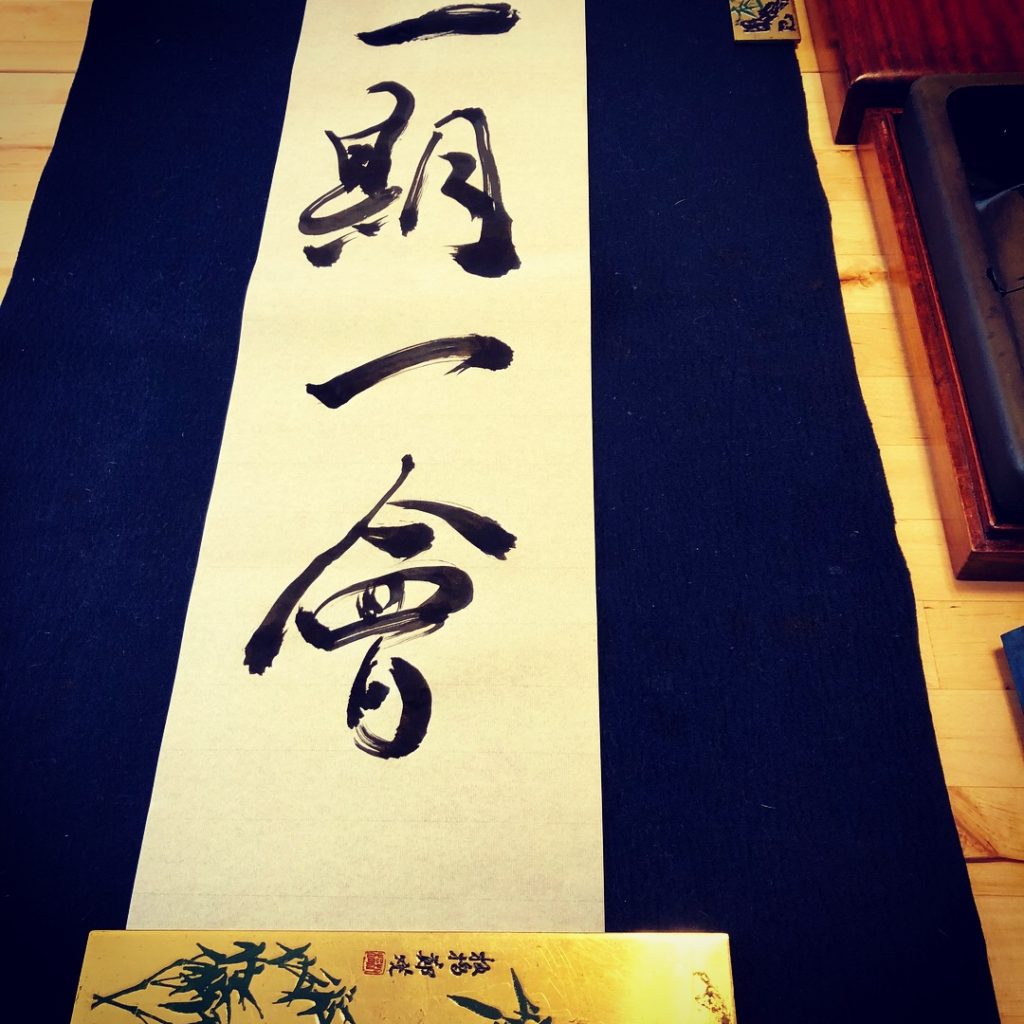
Japanese calligraphy Ichigo Ichie One in a lifetime meeting 一期一会
After receiving calligraphy tools from our grandparents, I started doing calligraphy again.
Soon after, I realized doing calligraphy is a good meditation.
Calligraphy is one of the main Japanese culture, and related to our history.
In our Japanese history, calligraphy is always in our life, same as ZEN (禅), Buddhism, temples, and tea ceremony.
Tranquility, simplicity, mindfulness, humbleness, are very important elements in these Japanese culture.
Also purifying tools and taking care of each item, how you treat these tools are also an inevitable part of its culture.
When we do calligraphy, we need to pay attention to our posture.
(We used to sit on our knees on tatami mat room with our back straight, but relaxing our shoulders)
It is important to hold the calligraphy brush with three fingers properly.
Relaxing our arm, making our wrist flexible, and focus on our breathing.
We need to write in one-stroke, and we are not allowed to go back and fix the line again.
So First stroke is the last stroke.
That is why how much we soak our brush into black ink, how fast we write, how strong we put our brush onto paper, are all very important.
For example, I am not satisfied with one line, as it was not black enough and the color was little too thin, so I might want to go back and color on top with more ink.
However, if I do that, it will appear as a mark even after it gets dry, and it doesn’t look nice.
That means, we have to picture and simulate the writing in our mind, before we actually write on the white paper.
And once I start writing, there is no stopping, no going back, nor fixing.
First trial is the real performance.
This is “一期一会”(Ichigo-Ichie) “Once-in-a-lifetime-meeting”.
This one moment never repeat, everything we experience in every second, every minute is only one time.
So we have to treasure this one moment.
However if I think too much, probably I hold my brush too tight, that doesn’t give me a good result either.
So when we do calligraphy, we need to breathe deeply, empty our mind, listen to the sound of outside wind or birds(not car noise), relax our mind, and start writing.
This is the same procedure as meditation.
Of course, opening our eyes and keep writing our calligraphy is not exactly the same as meditation.
But while doing calligraphy, I find myself very calm.
Japanese culture is very sensitive.
We want to keep this sensitivity and beauty in our everyday life.